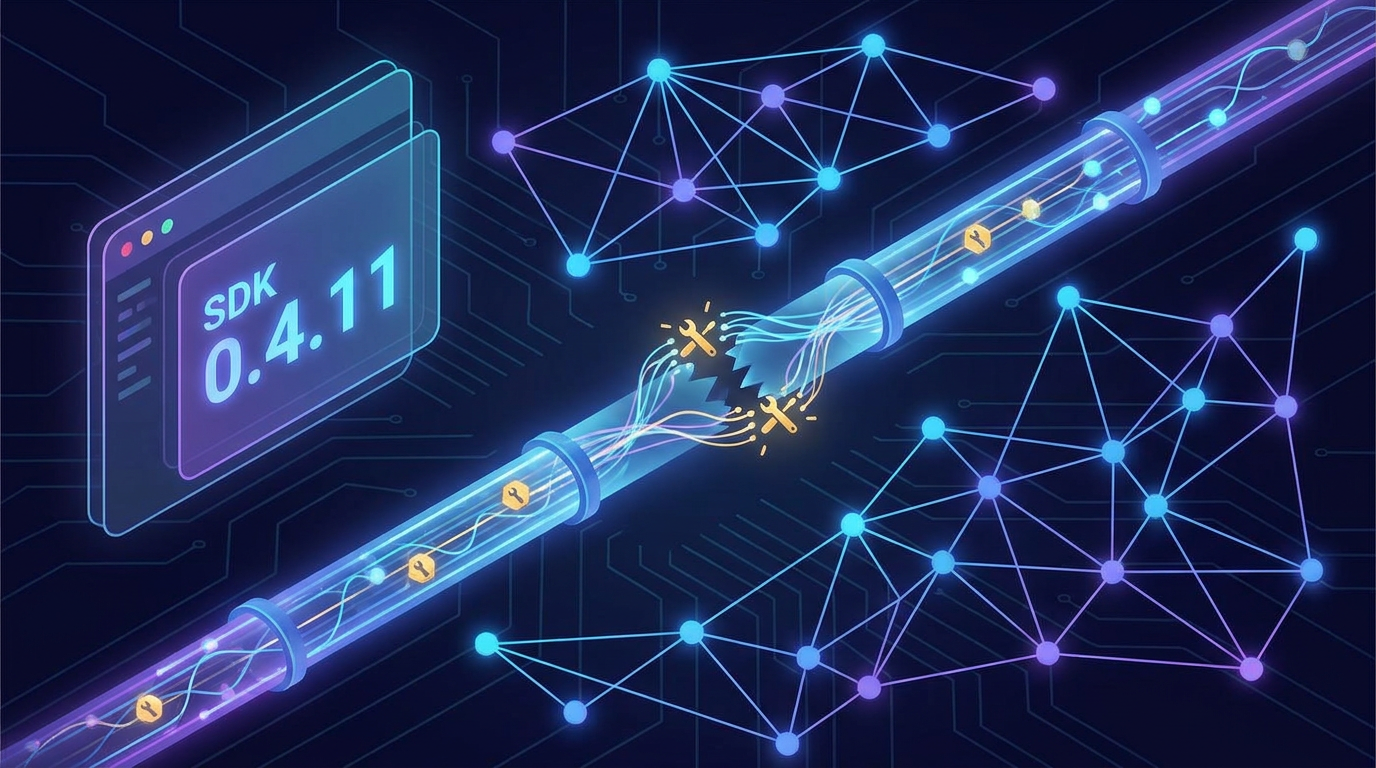
LangChain has released version 0.4.11 of langgraph-sdk, the Python client used to talk to deployed LangGraph agents. According to the GitHub release notes, this is a maintenance release: most entries concern what happens when a streamed connection to an agent run drops and the client has to reconnect.
For teams running agents in production, that is the moment where events can be lost, duplicated or left hanging. The changes in 0.4.11 aim to make those reconnects more predictable rather than adding new features.
The release matters most to developers who stream agent output to users or wait on long-running runs from Python code. If you are new to the vocabulary, the AI glossary on AiLunaPro explains terms such as agent, run and workflow.
What changed in LangGraph SDK 0.4.11
The release notes list a series of fixes to the Python SDK. They fall into three groups: reconnect and retry behaviour, correctness of streamed data, and a typing fix for authorization handlers.
Retries with backoff when reconnects fail
Two fixes add retries with backoff, meaning the client waits progressively longer between attempts instead of retrying immediately in a tight loop. This now applies to stream reconnects that fail, and to reconnects made while calling runs.wait, join and cancel(wait=True). In practice, a brief network interruption during a long agent run is less likely to surface as an error in your application code.
More reliable streamed events
LangGraph streams run output using server-sent events (SSE), a standard way for a server to push a sequence of messages over a single HTTP connection. Each event can carry an identifier, and a reconnecting client sends the last identifier it received in a Last-Event-ID header so the server can resume from the right point.
Release 0.4.11 changes how the client handles this in several ways:
- SSE data and the reconnect cursor are now kept intact when an event arrives split across several network chunks.
- The client emits a warning if it reconnects to a stream without a
Last-Event-ID, which signals that resumption may not continue from the expected event. - A new test checks that a reconnect loop picks up after the most recent event, guarding against replaying older output.
Authorization typing fix
One entry adjusts the type overload for Auth.on so that it matches optional resources. This affects developers who write custom authorization handlers and rely on type checkers; it is not expected to change runtime behaviour, though the notes do not say so explicitly.
Who should consider upgrading
The release is most relevant if your application streams LangGraph output to a user interface, waits synchronously on runs, or cancels runs and waits for confirmation. Those are the code paths the retry and reconnect fixes target.
If you only use the SDK for short, non-streamed calls, the practical impact is likely to be small. Either way, the GitHub releases page for the repository is the place to confirm which SDK version is current before you pin a dependency, since maintenance releases in this project tend to follow each other closely.
Limitations and open questions
The release notes are a list of pull request titles rather than a migration guide. They do not describe performance effects, default retry limits or whether any behaviour change requires code updates. Teams with strict reliability requirements should read the linked pull requests and test reconnect scenarios in staging before upgrading production services.
Why this matters for businesses
Agent projects often fail in production not because of the model, but because of plumbing: dropped connections, duplicated events and runs that never report completion. Releases like this one reduce that operational risk for teams building on LangGraph. If you are planning or scaling agent workflows, our overview of how custom AI agents fit into a growth team and the broader context in the shift toward agentic AI automation can help frame where reliability work belongs in your roadmap.
This article reflects the published release notes for langgraph-sdk 0.4.11.
Put this AI capability into practice
Understanding the technology is only the first step. AiLunaPro can help your team turn this capability into a controlled operational workflow.
With AiLunaPro Custom AI Agents and Automation, you can:
- Helps teams assess whether an SDK update reduces reliability risk in their agent workflows
- Highlights the operational details, such as reconnects and retries, that affect production agents
- Supports planning of staging tests before upgrading agent infrastructure


